
Not If You Live Here
I'd been walking the shoulder of Route 66 with a camera for the better part of an hour, doing the thing I do in these little towns, which is stand too long in front of buildings other people are happy to drive past. She was leaning against a green Blazer with her daughter beside her, a girl of twelve or so who'd reached the age where a parent's errands feel like a sentence to be served. The woman watched me a while before she asked why I was taking pictures. There was no edge to it, which isn't always the case with a stranger photographing a town that's seen better days. She just wanted to know.
I told her it was a cool little town.
"Not if you live here," she said.
There was no animosity in it. It was just an honest statement from experience, and then she loaded her daughter into the Blazer and pulled onto the highway that used to be the most famous road in America. I've thought about it for months. I'd been photographing the peeling paint and the dead neon and the rust coming up through the sign frames, and to me that was the town wearing its history on its face. To her it was the parking lot she stood in every week, and the road out of it, and a kid getting old enough to ask what there is to do here. That's the gap I keep coming back to. A place can be a photograph to the person passing through and a problem to the person who stays, and both of them are looking at the same street.
Nobody stumbles into northeast Oklahoma. You come here on purpose, or you come here because the road brings you, and for most of a century the road brought everybody.
Afton was a railroad town first. The tracks reached this corner of the Cherokee Nation in 1871, a post office followed in 1886, and the place got its name the good way names sometimes come, by accident and affection. A Scottish surveyor working the line is said to have named the stop for his daughter, who'd been named for the River Afton back in Scotland, the one Robert Burns asked to flow gently in his poem. Then a second railroad came through in 1901 and made the town. Afton became a Frisco Railroad division point, which meant a repair shop, a turntable, a roundhouse, and a payroll of men whose whole living was keeping the trains running. By 1910 the town held better than twelve hundred people, two schools, two banks, a creamery, a brick plant, a newspaper, mills, and grain elevators. The population topped out at 1,518 in 1920, and everyone who kept track of such things figured Afton would just keep growing.
Then Route 66 came through in 1926 and gave the town a second reason to exist. The highway did what the railroad had done a generation earlier. It kept the strangers coming, and it kept them spending.
For a while there were a lot of strangers. In the thirties the road filled with Dust Bowl families driving west with everything they owned lashed to the car, chasing work in California, and Afton was a place along the way to buy gas and a sandwich and maybe a night's sleep before pushing on. During the war the same road ran heavy with trucks hauling munitions between the California ports and the rest of the country. And then the fifties turned Route 66 into America's vacation highway, the way to the Grand Canyon and Los Angeles, and the traffic came in seasons, spring and fall for the long-haul drivers and summer for the families with kids in the back seat. Afton caught a break there too. Grand Lake o' the Cherokees opened just southwest of town in 1940, so on top of everyone passing through, Afton got its own summer crowd coming to fish and swim. The town wasn't a stop on the way to somewhere for those few months. It was the somewhere.
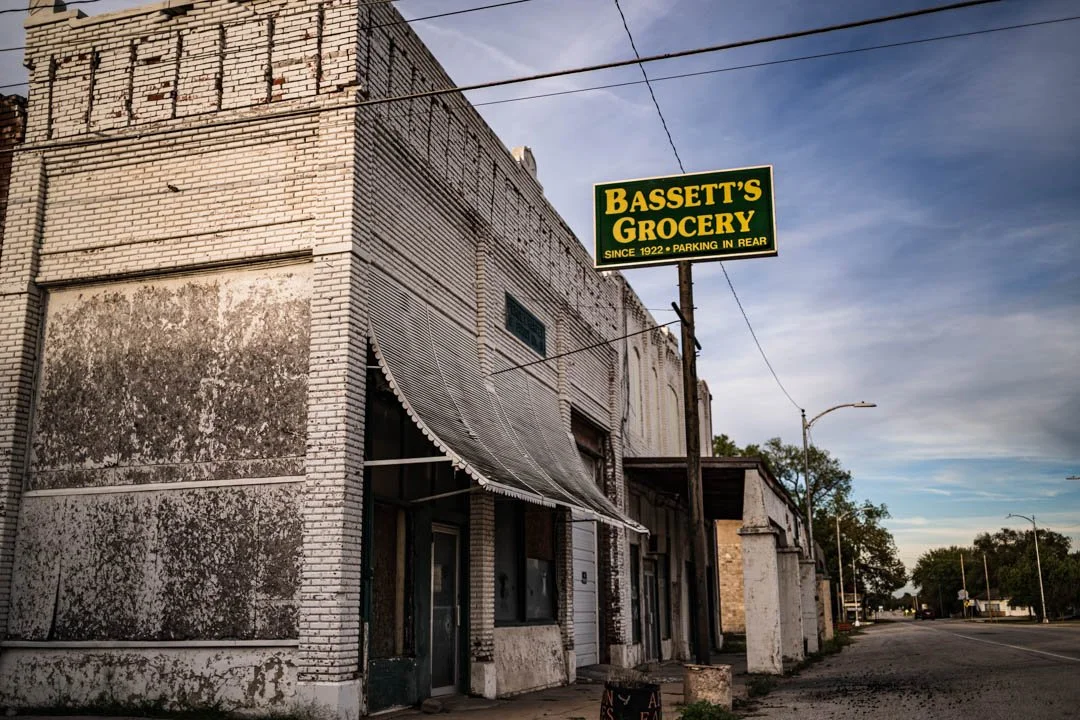
You can still read what that felt like on the buildings, if you know to look. There's a green and gold sign hanging over a white brick storefront downtown that says BASSETT'S GROCERY, SINCE 1922, PARKING IN REAR. The store's been closed for years now, the windows papered over, an old canvas awning sagging off the front. But the sign's still up, still bright, still telling an empty sidewalk where to park. Somebody kept a grocery going on that block for the better part of ninety years. The sign is the town talking to a crowd that stopped coming.
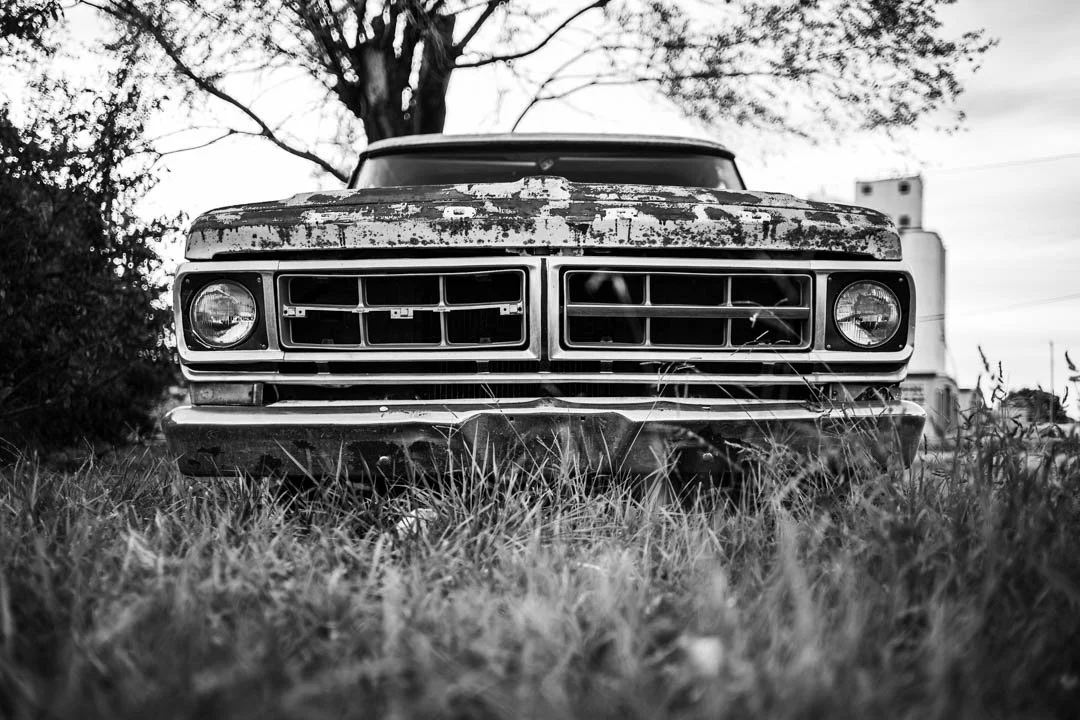
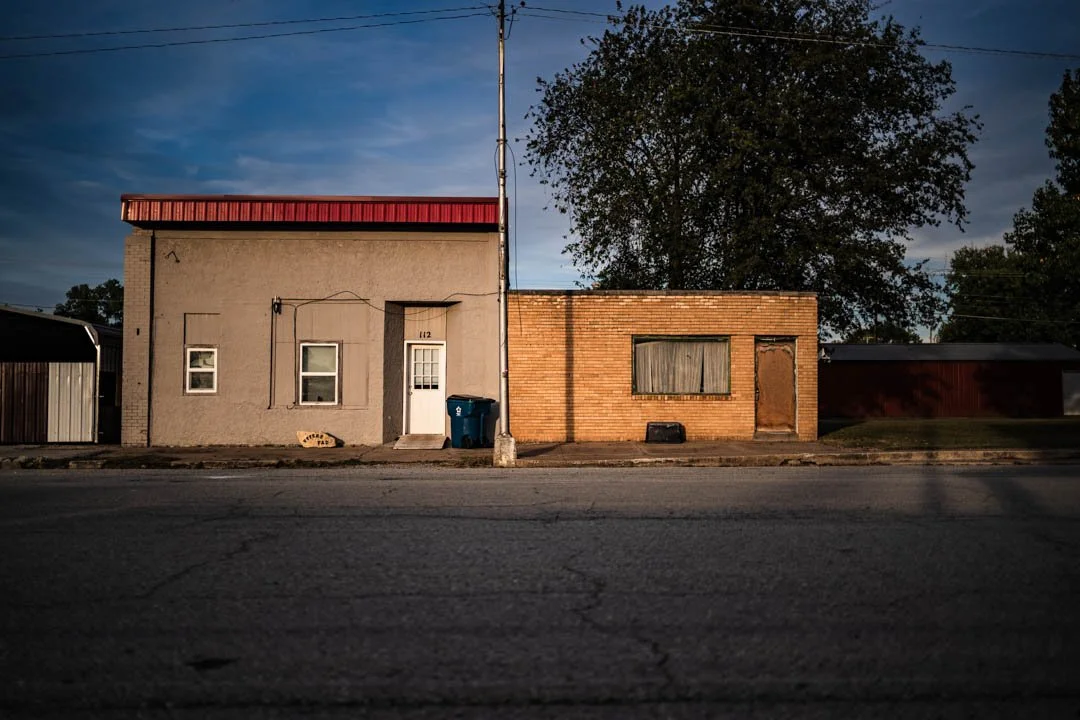
Not that the town's gone quiet. The road still runs right down the middle of it, and the afternoon I was there it carried a steady trickle, a semi shifting down through the light, a knot of motorcycles, a car with Illinois plates driving the old road on purpose. About seven hundred people still live here. They've got a barbecue joint and a funeral home and a towing outfit and three churches keeping their doors open. While I worked one side of the street and came back down the other, a woman in a red outfit sat out front of a little metal house and watched me the whole time. We never spoke. She didn't seem to mind me and she didn't seem curious either. I was just a thing happening on the street that day, a man with a camera, and she was home. So when I tell you what's been lost here, understand I'm walking through a town that's still very much lived in.
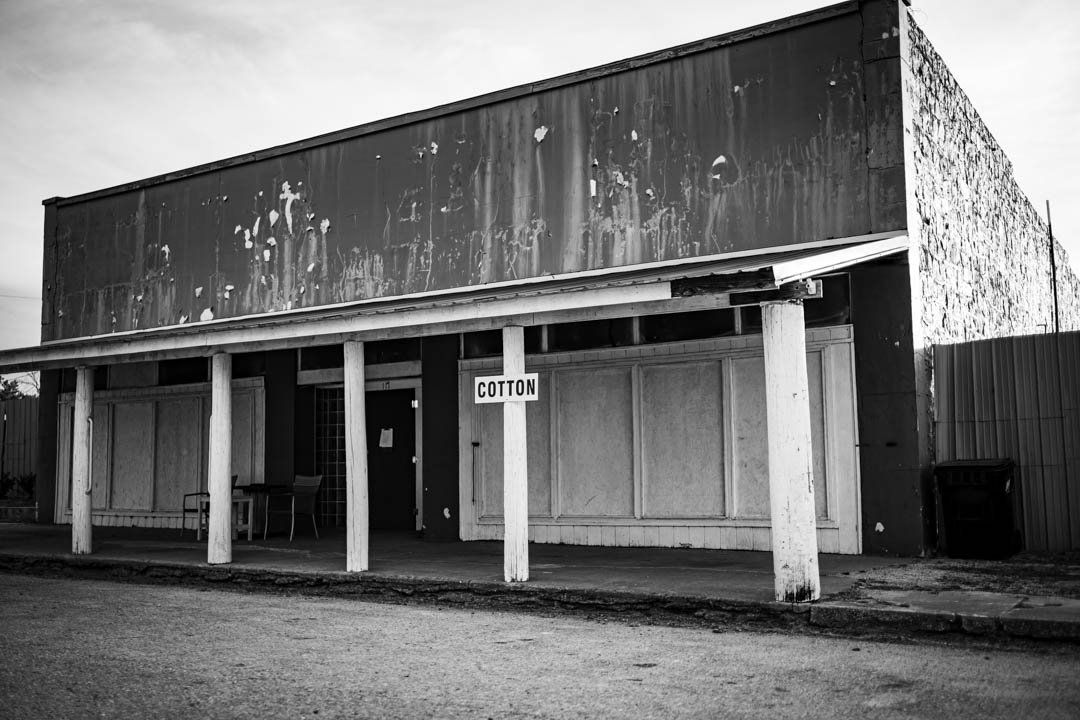
The interstate opened in 1957, and it didn't kill Afton. It just quietly closed the valve that fed it.
That's the part people get wrong when they call a place like this a ghost town. There's no single terrible morning. I-44 ran the through-traffic around Afton about a mile north, and a mile is all it takes. The families and the truckers and the vacationers found the faster road, and the businesses that lived on strangers slowly ran out of strangers. The decline actually started earlier than the sign of it. The railroad repair shop had already closed and the roundhouse had come down back in the thirties, so the town lost its first foundation while it still looked, from the highway, like it was doing fine. The interstate just took the second one.
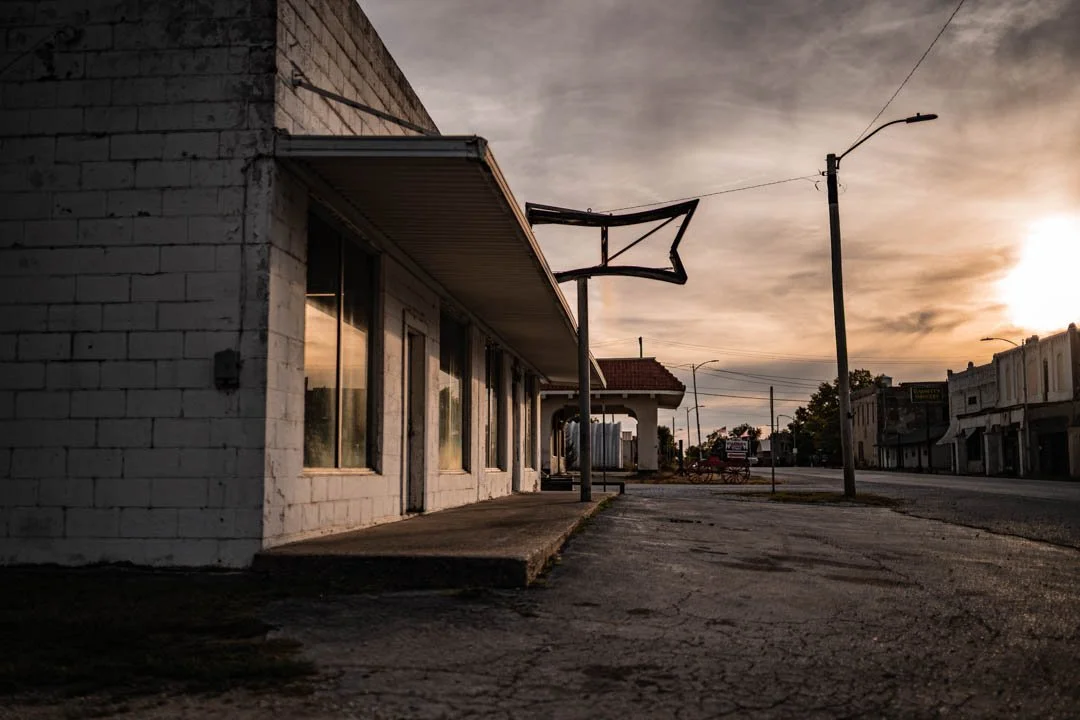
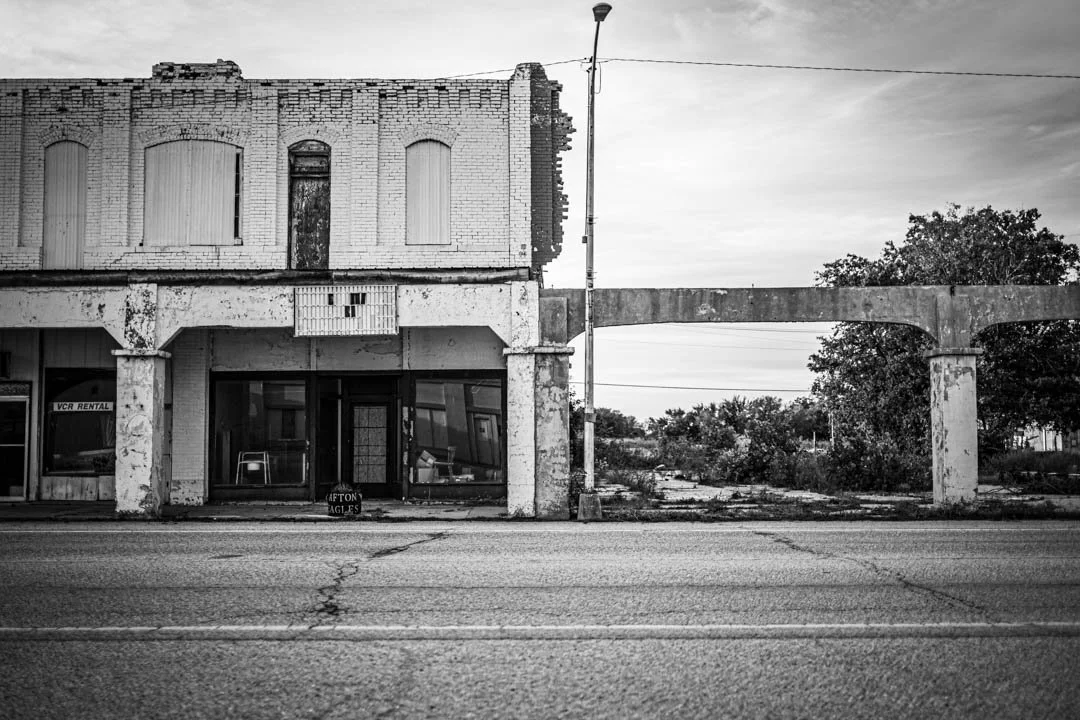
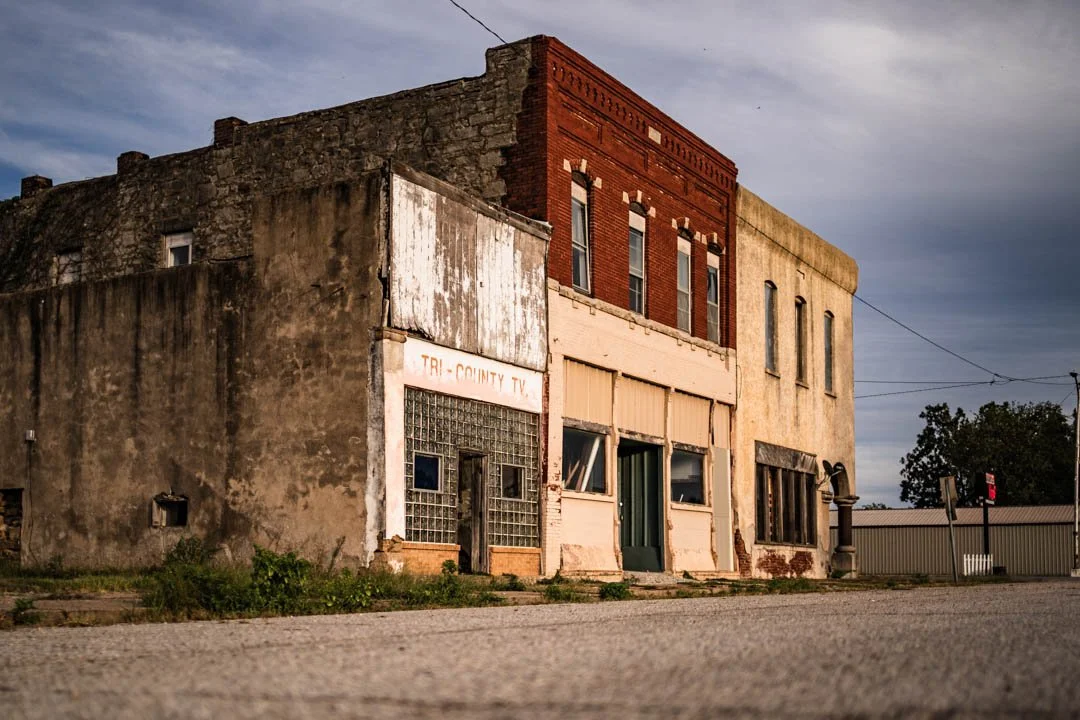
What that looks like now is a downtown that's mostly still standing and mostly empty. There's a three-building run near the corner where a rough stone facade meets red brick meets stucco, all of it at slightly different heights, and set into it is a storefront with faded red letters over glass block that read TRI-COUNTY TV. A shop that fixed televisions, behind a glass-block front somebody once paid good money to make look modern. Down the block a storefront still has VCR RENTAL painted on the window. A business that died everywhere in America, sitting dark in a town that's been dying longer, and next to it a gap where a building used to stand. You can see where its neighbor came down. There's a stub of porch reaching toward nothing and the old tile floor still laid in the dirt, the outline of a room with no room around it. Some of that's the Palmer Hotel fire, which took several downtown buildings in 2019, red brick that had stood since 1911. The old checkered tile floor is still visible, faded under time and the sun.
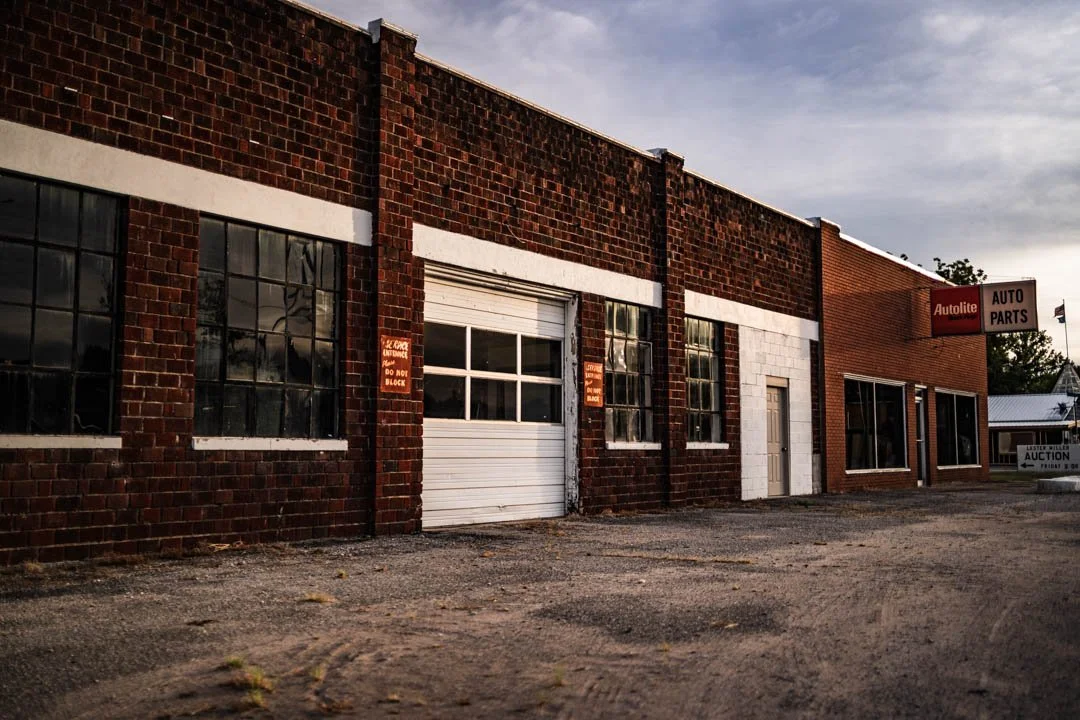
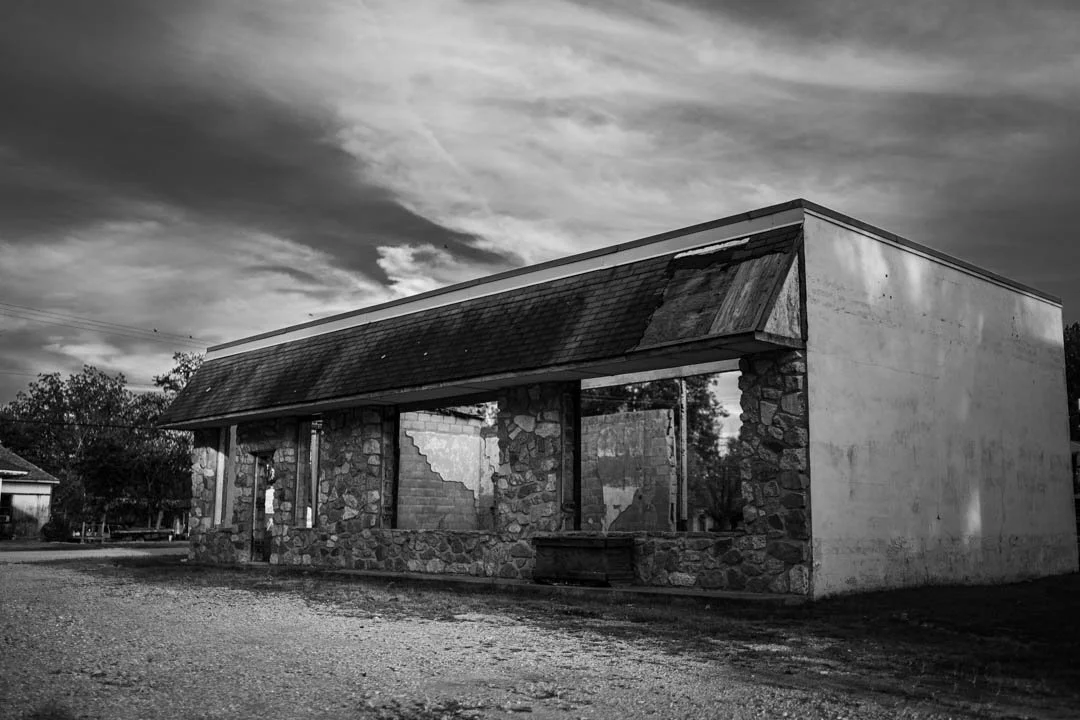
Afton’s prospects rose and fell with the traffic coming through town so it’s no surprise some of the remnants point to that history. There's a low concrete garage on the edge of town with two roll-up doors and a ghost sign across the top you can just make out in raking light, TIRES, TUBES, BATTERIES, a vine growing through the gap between the bays. There's a filling station a little further out that's nothing but its concrete skeleton now, roofless, three service bays open to the sky. And there's a brick building on the main drag with a lit-cabinet sign still bolted to the corner, AUTOLITE SPARK PLUGS, AUTO PARTS. The plate glass is intact, and through it you can see boxes and shelving stacked up inside, the place kept on as somebody's storage. That one isn't a ruin. It's just closed, recently enough that the lights could probably still come on. An auto parts store ought to be the last business standing in a town like this, and it's closed too.
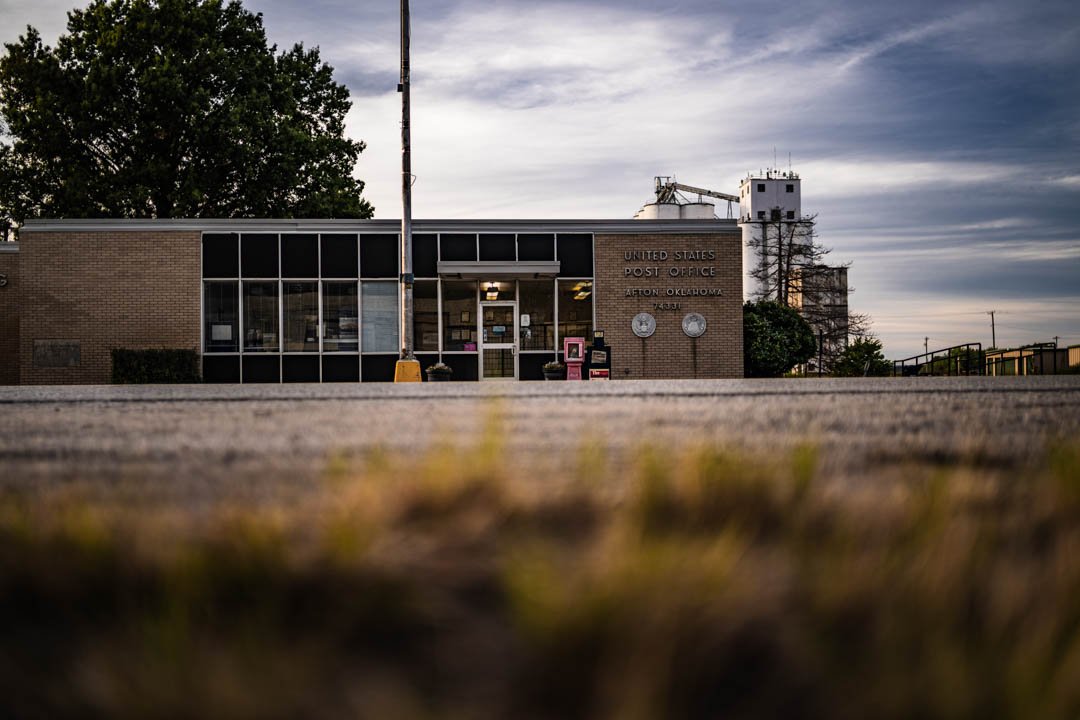
The post office is a nice low-slung brick and glass box, mid-century modern, the kind of small-town federal building that felt like the future in about 1958. Somebody built that on the bet the town was going somewhere. The trains still come through, too, freight now, on a line that runs a couple hundred yards behind 66 past a tall white concrete grain elevator. They don't stop. A hundred years ago the whole town was gathered around the fact of a train that stopped.
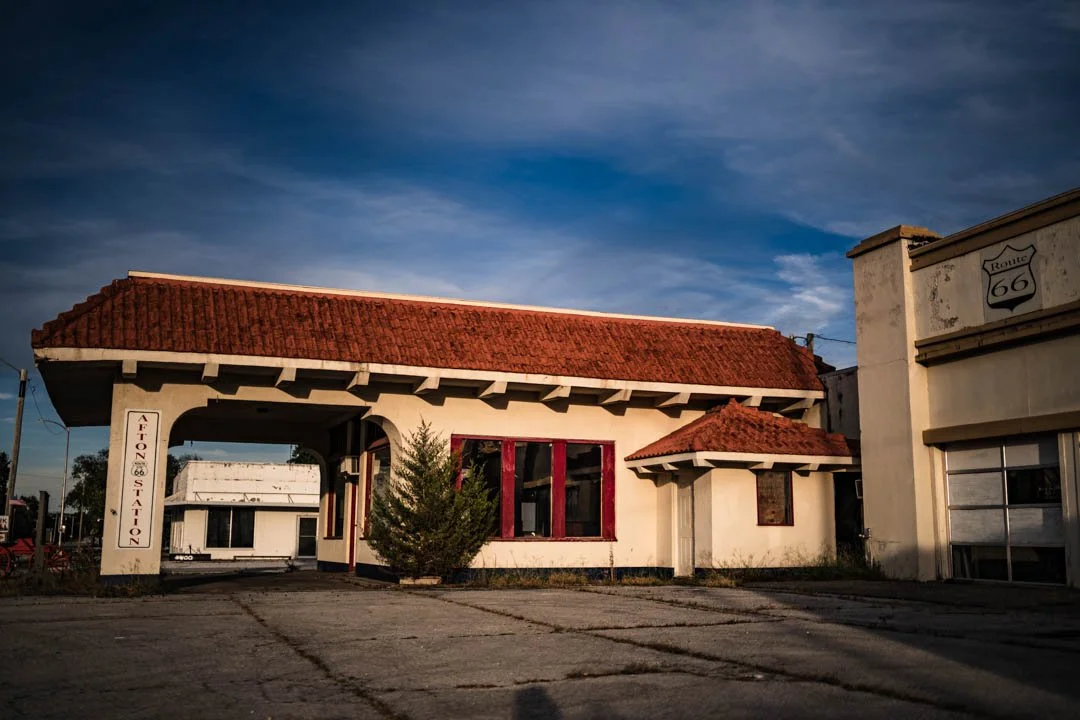
The old D-X station downtown is the one loss that says the most about how these places actually go. It's a trim little 1930s filling station with a mission-style front, and it was the first business on this stretch of 66 to stay open around the clock. It sold gas into the eighties and then closed like the rest. In 1999 a retired couple named Laurel and David Kane bought the building, restored it, and filled it with Packards, eighteen of them, along with a wall of Route 66 memorabilia and a set of the old pumps out front. They ran it as a free welcome center. For close to twenty years it was the reason a traveler stopped in Afton at all. People came from Europe and Australia and Japan, and the Kanes handed them a map and a little conversation and sent them on down the road. In 2009 the route named it Business of the Year. It ran, start to finish, on two people who loved it. Laurel died in 2016, David in 2018, the Packards were sold, and the building sits empty now. Nobody did anything wrong. There just wasn’t another couple who'd give their last good years to a gas station full of old cars, and so the light went out and hasn't come back on.
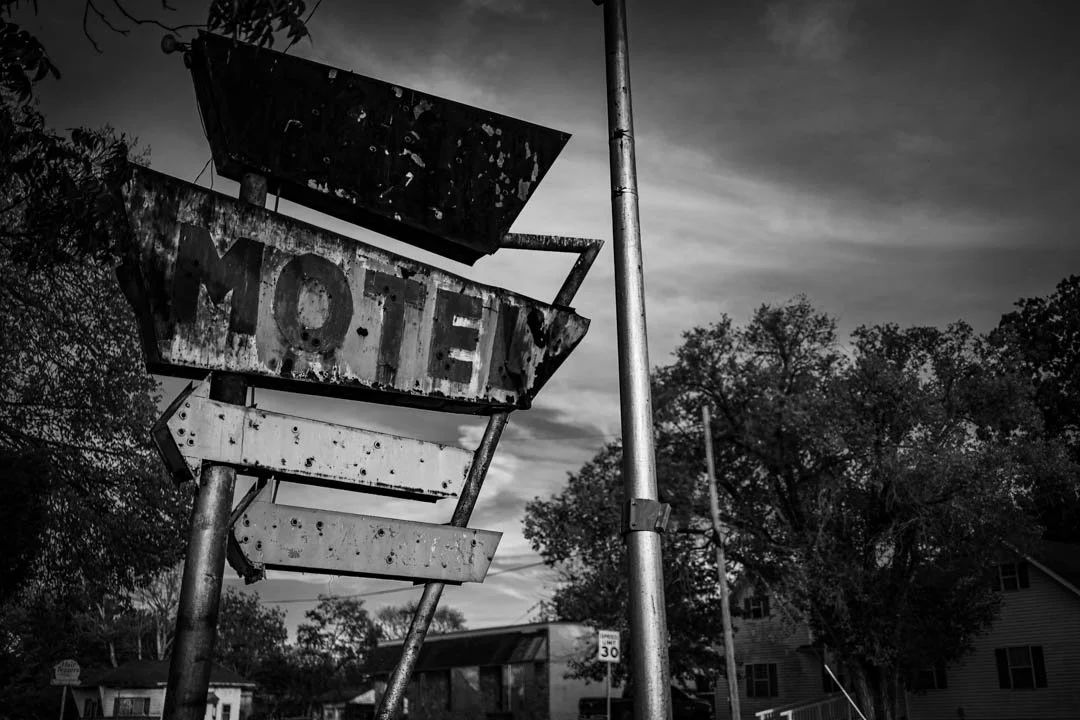
There's a way of loving these towns that quietly writes the living out of them. You come to see a ghost town, maybe take a few pictures, and the people who actually live there start to feel like they're in the shot. I've done it with a camera in my hand. The decay really is beautiful. The dead neon and the soft old brick and the light coming in sideways through a broken sign are the reason I drive two hours to get here. But that's a visitor's beauty, and it costs me nothing, because at the end of the afternoon I get in my truck and drive home.
The woman by the Blazer doesn't get to leave the frame. She has to buy her gas here and raise her kid here, in a town where the newest thing to arrive was a Dollar General. And she was generous enough to stand in that parking lot and tell me the truth about it instead of just letting me admire the ruins.
So I won't sell you Afton as a hidden gem. It's a real town living out the long tail of the transportation of the past. It's thinning, and the people who've stayed to watch it happen are the least sentimental people in this whole story.
You should still go. Stop at the gas station and buy something, say hello to whoever's working the counter, take your pictures. Just keep one thing in mind while you frame them. For you it's a cool little town. For the people who live there it's Tuesday.